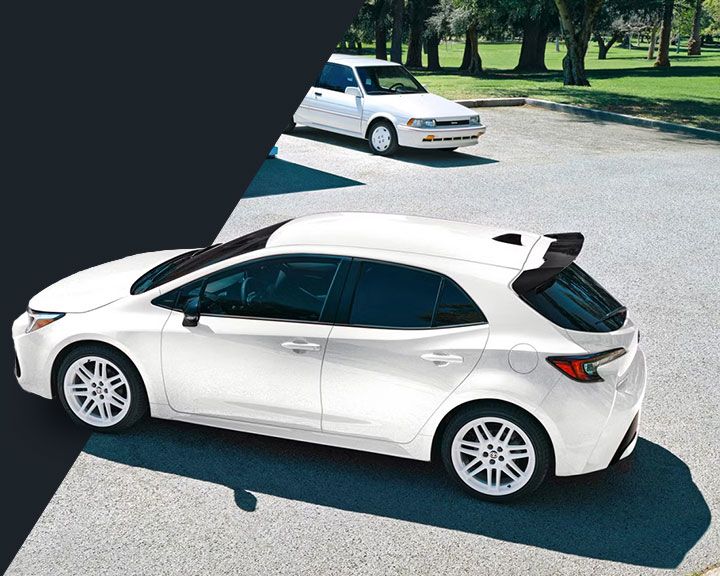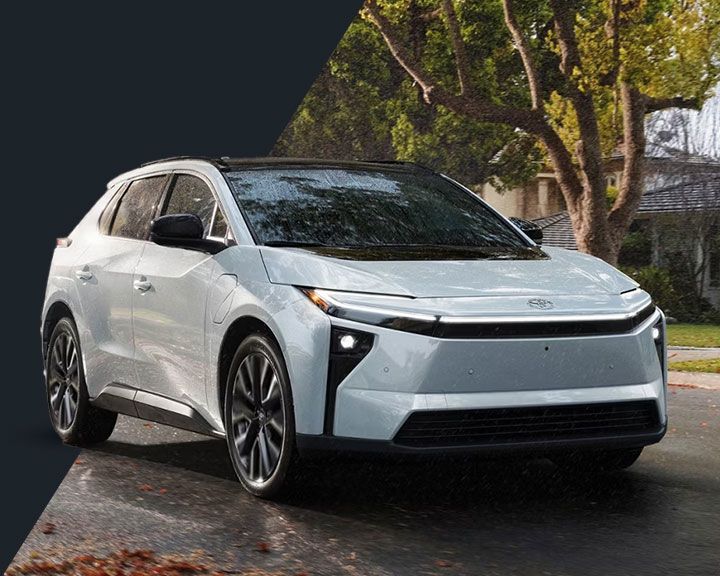
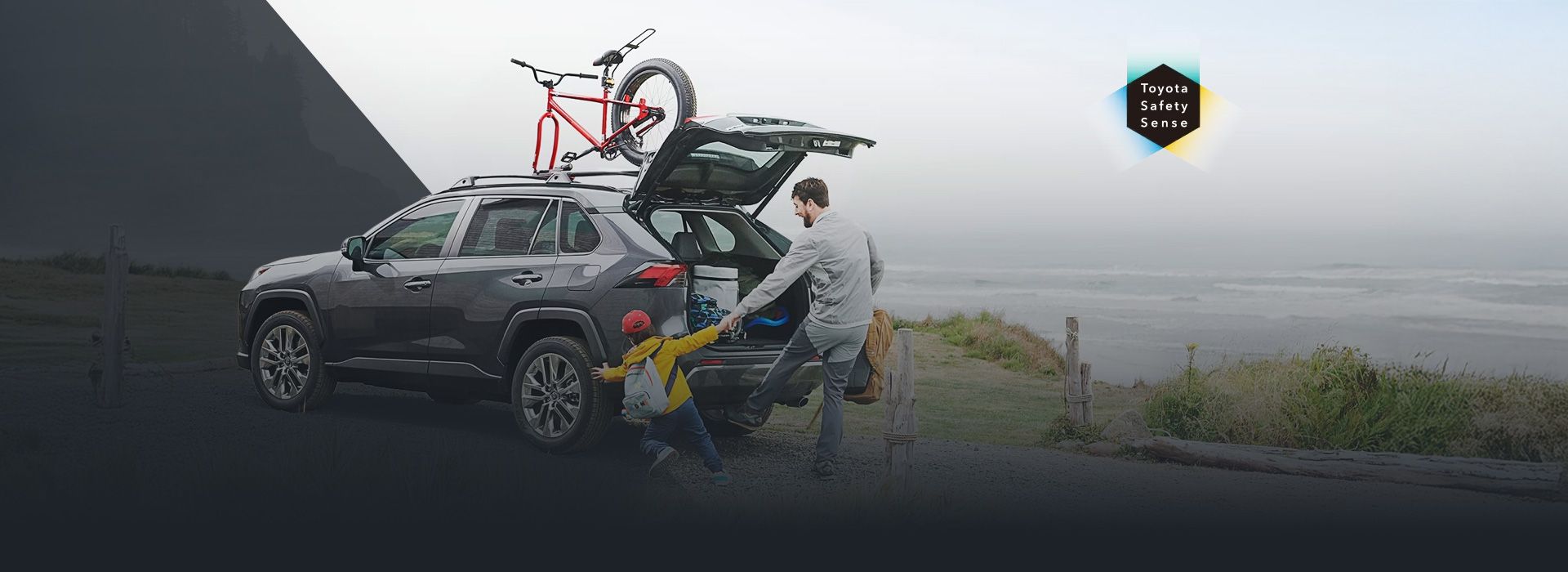
A family prepares for adventure next to their grey Toyota RAV4 equipped with a bike rack, featuring the Toyota Safety Sense logo against a misty coastal backdrop.

OUR COMMITMENT TO SAFETY

OUR ULTIMATE GOAL: A WORLD WITHOUT ACCIDENTS

For Toyota, safety on the road is - and will always be - one of the top priorities. Toyota commits to continually innovate and improve its safety technologies to offer a safer experience for all. This commitment has been recognized with multiple awards from the Insurance Institute for Highway Safety (IIHS).

Integrated Technologies

For safer driving experiences, Toyota offers an integrated system of active and passive security technologies, bringing together every area of driving.

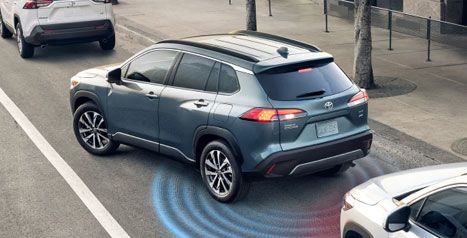
High-angle view of a blue Toyota Corolla Cross parallel parking, with blue and red graphic waves illustrating rear parking sensors and assist technology.

Parking

To assist during parking maneuvers and backing up, Toyota has developed a range of technologies that increases your field of vision. Among these, there are the Backup Cameras with Guidelines for backing into parking spaces, a Rear Cross-Traffic Alert System that warns of the presence of approaching vehicles, and Intelligent Parking Assist that can park a vehicle with only minimal intervention from the driver.
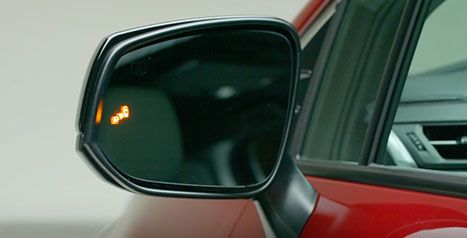
Close-up of a red Toyota vehicle's side mirror, showing the illuminated orange Blind Spot Monitor warning icon.

Active Safety

On the road, the unexpected can occur at any moment and active safety technologies are there to help you in those types of situations. Active safety technologies include Blind Spot Monitor, Lane Departure Alert with audio and visual alerts as well as Lane Departure Alert with Steering Assist that can lightly steer your vehicle back into your lane. Traction Control limits wheel spin on slippery surfaces whereas Vehicle Stability Control allows for better control on slippery surfaces. Active safety technologies also include Anti-Lock Brakes, Electronic Brakeforce Distribution for more stability during braking, and Brake Assist to prevent collisions. Other included technologies, like Vehicle Dynamics Integrated Management, are incredibly advanced and can automatically anticipate and activate security systems. This allows the driver to have the highest level of safety and control possible.

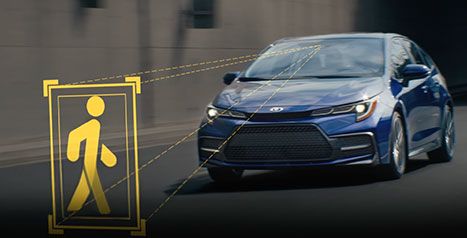
A blue Toyota Corolla driving on an urban road, featuring a yellow graphic highlighting a pedestrian to illustrate the pre-collision detection system.

Pre-Crash Safety

In some cases, accidents are unavoidable. For these situations, Toyota has developed pre-collision safety. This technology can reduce damage and injury by warning you when the radar detects an obstacle, applying the brakes if you fail to do so and tightening the seatbelts. Pre-collision safety technologies can analyze and predict the likelihood of a collision and apply necessary measures to reduce injury.

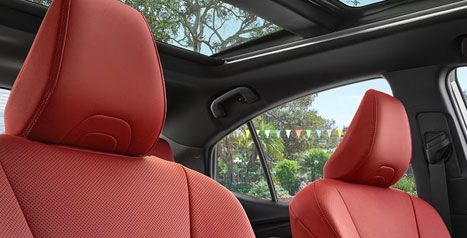
Interior view of a Toyota vehicle featuring red leather sport seats and a panoramic sunroof, highlighting the cabin's safety structure and design.

Passive Safety

Many components of Toyota vehicles contribute to the vehicle's passive security, including airbags and seatbelts. The structure of the body can also absorb and distribute impacts to minimize damage. Other passive safety features include specially designed headrests that reduce the effects of important impacts.

Continually Enhancing Safety

The safety of the Toyota products we offer is key. We continually invest in research in order to enhance and improve the quality of our vehicles and their components, to keep you safe. We aspire to be the leader in the safety field so every drive can be enjoyed in complete confidence and serenity.

Toyota Safety Sense TM1

Toyota believes that everyone deserves a safe driving experience. That's why the Toyota Safety Sense (TSS) suite was developed and comes standard on the majority of our models. This suite of advanced active safety technologies improves driver awareness and vehicle operation.

The integrated TSS system improves safety in three areas: preventing and mitigating certain types of frontal collisions, maintaining the vehicle in its lane and improving night-time driving safety. Road safety starts with the prevention of potential accidents!

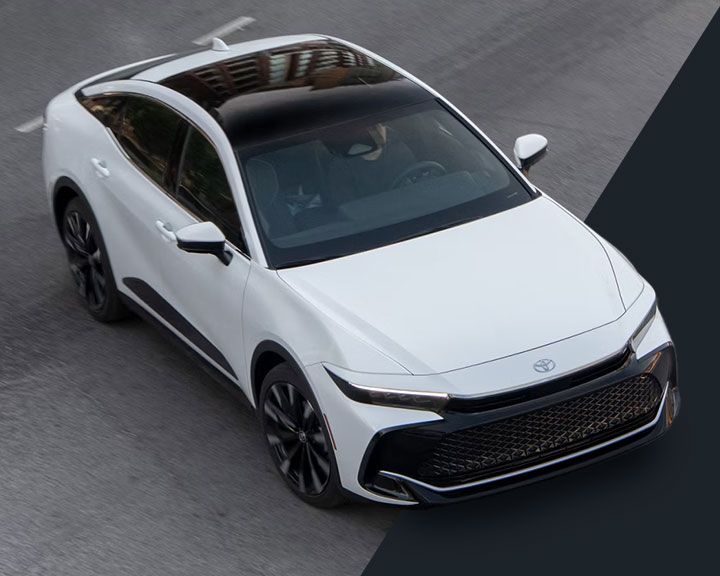
High-angle view of a white Toyota Crown with a black panoramic roof driving on an asphalt road.

TSS 2.0

Toyota’s newest advanced active safety system.

TSS 2.0 includes TSS-C's technologies and adds, among other features, a Pre-Collision System with Pedestrian Detection as well as Lane Departure Alert with Steering Assist and Road Edge Detection.

Learn more
Official "STAR SAFETY SYSTEM" logo with "STAR" in red and "SAFETY SYSTEM" in black on a white background.

The Star Safety SystemTM, launched in 2011, includes six accident prevention technologies that improve the stability, braking and traction of the vehicle.

A black circular outline representing a wheel with a red curved bracket on the top left, indicating worn brake pads.

Electronic Brakeforce Distribution

A black circular outline representing a wheel with a red curved bracket on the top left, indicating worn brake pads.

Brake Assist

A black circle containing a red circle with a black exclamation mark in the center, signifying a general brake system fault or low fluid.

Smart Stop Technology

A black front-facing silhouette of a car with two red wavy lines underneath, indicating that the traction control system is active or has a fault.

Vehicle Stability Control

A black circle containing a red circle with the letters "ABS" written in black in the center.

Anti-Lock Brake System

A black circular outline representing a wheel with a red curved bracket on the top left, indicating worn brake pads.

Traction Control

Excellence that Relies on Quality

The quality, reliability and durability of Toyota vehicles are world-renown, ensuring years of safety on the road.

Rigorous Collision Testing

To ensure optimal safety, more than 600 Toyota vehicles are submitted to intensive crash testing every year. By placing sensors on the prototype vehicles, we can examine the effects of each collision and develop ways to improve the design of our vehicles. Repeating these tests over and over allows us to develop safe vehicles for every collision scenario.

Triple Verifications

When it comes to the safety of our vehicles, we never take any risks: every component of the vehicle is checked three times rather than only once. Take our airbags, for example. The electronic connections for the airbag system have gold-plated terminals, which makes them immune to corrosion, but are also inspected three times on the production line before being installed in a vehicle.

Discover Our Services

Lorem ipsum dolor sit amet, consectetur adipiscing elit. Quisque diam lectus, semper et rutrum ut, molestie ac justo. Donec id rhoncus dui, eu convallis mi. Morbi eget ipsum ac turpis pulvinar viverra feugiat tincidunt dolor. Suspendisse vitae diam varius, sodales tortor nec, aliquam odio et rutrum ut, molestie ac justo.

White "TIRF" logo inside an orange diamond shape.

Traffic Injury Research Foundation (TIRF)

Canada's world-renowned TIRF aims to better understand the causes of traffic injuries and develop mitigating programs and policies. Since 2002, Toyota has been a proud partner of the TIRF, contributing to the research and creation of educational material to help young drivers better understand today's road safety issues.

"kartSTART" logo with "START" in red, above a grey checkered line.

kartSTART

kartSTART, a hands-on program on driving, uses go-karts to educate young drivers on the demands and dynamics of life behind the wheel. Toyota also supplies vehicles to introduce older drivers to the latest vehicle safety technologies, so they can get the most out of our Star Safety System.

Blue "CSRC" (Collaborative Safety Research Center) logo on a white background.

Collaborative Safety Research Centre (CSRC)

Launched by Toyota in 2011, the Collaborative Safety Research Centre (CSRC) aims to serve as a catalyst for the advancement of road safety in North America. With partnerships with universities, hospitals, research institutions and federal agencies, the CSRC commits to sharing the results of its research so everyone can reap the benefits.